Five Days Wandering Around Montreal
I’ve just spent five days wandering around Montreal. Next up is Vancouver for a few more.
I will compare the two cities after I get back from Vancouver. For now, here are some loose impressions of Montreal.
1. A Peculiar Kind of Ease
Canada is laid-back in general. That is nothing new. But Montreal felt relaxed in a different way from the rest of Canada I had experienced.
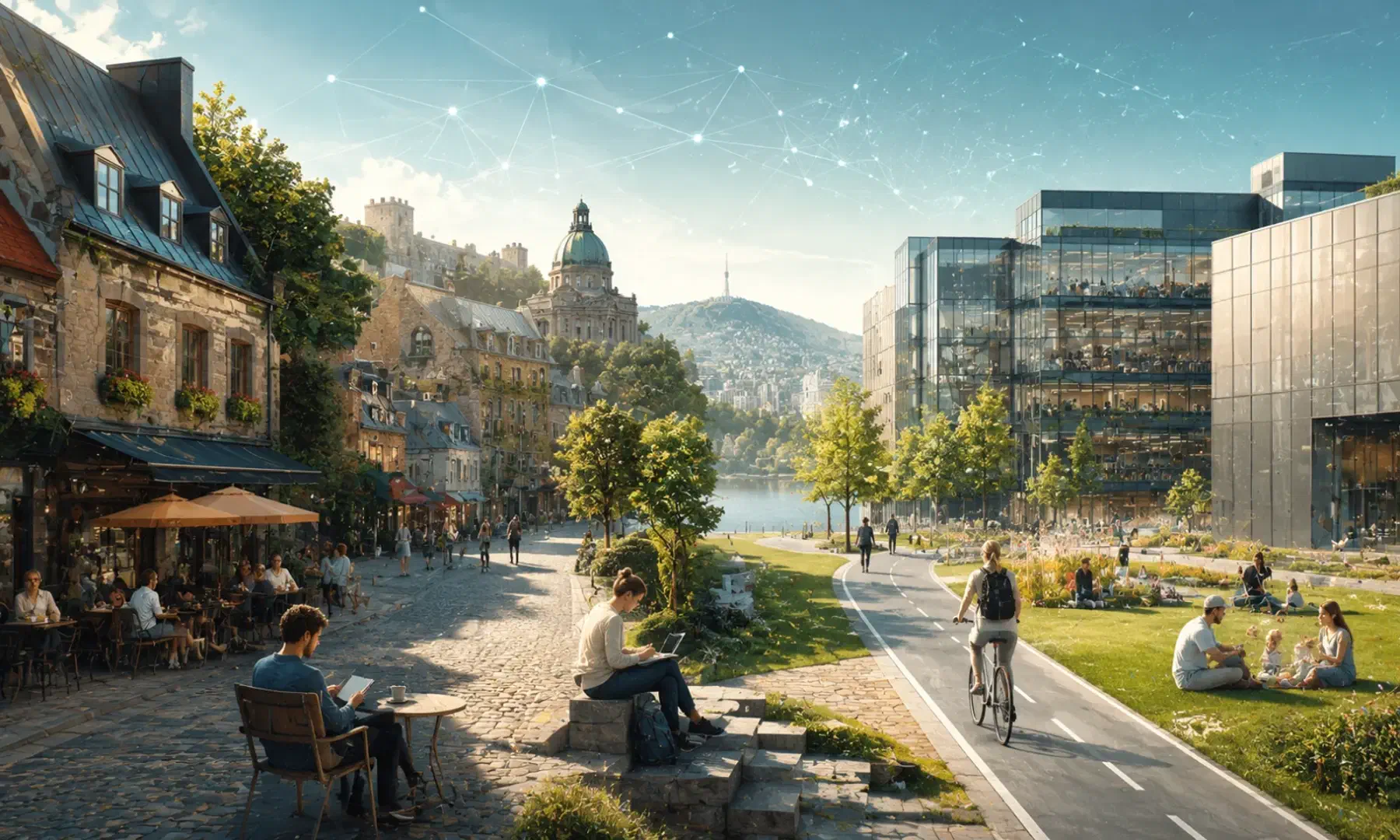
I felt it most strongly in a few places: in front of Notre-Dame Basilica, on the grass beside the river in the Old Port (Vieux-Port), and along the winding little streets of Old Montreal.
In the square outside the basilica, a street musician was playing while students ran around laughing. People sat on the steps or outside cafés, stretching in the sun.
Many of them wore the relaxed smiles of people who had never been beaten down by society.
That was how it felt to me: they were not stealing a breather between bills, KPIs, mortgage payments, and messages from the boss. They genuinely had time.
The waterfront at the Old Port had the same rhythm: the river, the wind, families lying on the lawn, and cyclists rolling by at an unhurried pace.
Several small galleries sit along the old streets, with nobody at the door collecting admission. You walk in, say “Bonjour” or “Hello,” and browse as long as you like. The art is neatly displayed; nobody watches over your shoulder, and nobody pushes you to buy.
These are tiny details, but they make you realize that a city’s sense of ease cannot be manufactured in a tourism commercial.
2. Expensive and Cheap Live in Separate Worlds
Canada has a high cost of living. That is certainly true.
But my impression was that anything tied to labor or services is expensive, while standardized industrial goods are not necessarily so. Some are even cheaper than in China.
Hotels are genuinely expensive. On this trip, I often saw very ordinary two-star rooms listed at CAD 100–200 a night. A plain three- or four-star hotel—roughly comparable in experience to China’s ubiquitous midrange JI Hotel chain—can easily cost more than RMB 10,000 for five days. In the central districts during peak season, CAD 500–600 a night for a high-end hotel is nothing unusual.
This is beyond “a bit pricey.” The bill abruptly reminds you that labor and property costs here run on an entirely different formula.
Eating out is expensive too. After tax and tip, a proper dinner for two routinely lands anywhere from the high double digits to CAD 100–200. At roughly RMB 5 to CAD 1, converting the total into yuan has a way of waking you up.
Groceries are less outrageous. The beef, pork, and chicken prices I saw, converted at the prevailing exchange rate, were broadly comparable to Sam’s Club in Shanghai. Vegetables were somewhat more expensive, but not absurdly so.
If you are willing to cook, everyday food costs can be similar to Shanghai’s, and some items are even cheaper.
Once you separate the two categories, the logic becomes clear: what costs money is “someone in Canada doing work for you”; what stays cheap is “a standardized industrial product.”
The gap between labor costs and manufactured-goods costs is much wider in North America than in China.
Then there are taxes, which are impossible to avoid.
Quebec is unusual in that it collects its own provincial income tax. Residents generally file one return with the federal government, through the Canada Revenue Agency, and another with Revenu Québec. Combined, the top marginal rate on ordinary income in 2026 is 53.31%, among the highest in Canada.
Sales tax also comes in two parts: the 5% federal GST and the 9.975% Quebec Sales Tax, for a total of 14.975%.
So the price printed on a restaurant menu is only the beginning. At checkout, first add roughly 15% tax, then another 15–20% tip, and the total jumps by a substantial amount.
On the other hand, Quebec’s childcare, healthcare, parental leave, and family benefits are also among the more generous in Canada.
The bargain here is not “low taxes, low burden.” It is “high taxes, high benefits.”
3. Fewer Indians
One thing I noticed about Montreal was how few Indians I encountered. On the way from the airport to downtown, in the Métro, on the street, among restaurant servers and shop staff, and among Uber drivers, the share of South Asians—especially people of Indian background—felt much lower than in other North American cities I have visited. They were certainly present, but nowhere near the numbers in Toronto, Vancouver, Seattle, or the Bay Area.
In the 2021 census, South Asians made up about 2.9% of Greater Montreal, compared with roughly 19.2% of the Toronto metropolitan area and 14.2% of metro Vancouver.
The reason is not hard to understand. For many Indian immigrants coming to Canada, the default path leads into the English-speaking world. Quebec is French-speaking, and Bill 101 and Bill 96 have progressively entrenched French as the dominant language of business, government, and education. Unless a new immigrant actively wants to learn French, they will naturally tend to look elsewhere.
That language barrier directly reshapes both the labor market and immigration flows. For locals, it reduces some of the population pressure coming from the English-speaking world. For outsiders, it is also quite literally a wall.
In any case, Montreal makes a wonderful impression. The streets are clean, and the old buildings are well maintained. The combination of Old Montreal’s stone streets and European façades with modern North American convenience is genuinely appealing. There are, of course, plenty of Chinese residents too, concentrated around Chinatown, the West Island, Brossard, and the South Shore. But they have not formed a parallel society large enough to feel mainstream, as in Richmond in metro Vancouver.
Montreal is not short on immigrants. It simply filters immigration through French.
4. An AI City You May Not Have Heard Of
If you only follow the headlines, the centers of AI are probably the San Francisco Bay Area and Seattle. But Montreal’s foundations in AI run surprisingly deep.
Yoshua Bengio, one of deep learning’s “big three,” shared the 2018 Turing Award with Geoffrey Hinton and Yann LeCun. He has taught at the Université de Montréal for decades and in 1993 founded the research community that eventually became Mila, the Quebec AI Institute.
Today, Mila is one of the world’s largest academic research centers for deep learning. Its official count is more than 1,400 affiliated members, spanning the Université de Montréal, McGill, Polytechnique Montréal, HEC Montréal, and other institutions. A cluster of major corporate AI labs has also gathered around Mila over the years: Google Brain Montréal, Meta FAIR Montréal, Microsoft Research Montréal, Samsung AI Center Montréal, RBC Borealis AI, and others.
Google Brain was later folded into Google DeepMind, while Meta’s and Microsoft’s organizations have also changed. But Montreal has not lost its position as an important academic node in AI.
The Quebec government has treated AI as a strategic industry since 2018 and has approved substantial five-year funding for Mila. At the federal level, there are also the Pan-Canadian AI Strategy and the SCALE AI supercluster.
On the street, in cafés, and on the Métro, I would occasionally see people walking around in Google hoodies or Mila T-shirts. Headphones on, laptop under one arm: unmistakably the research crowd.
But it feels different from the Bay Area.
Bay Area AI is about capital, startups, valuations, compute, and bidding wars for talent. Everything is geared toward turning the boom into fortunes. Montreal’s AI scene feels more like an academic anchor: excellent research, strong government backing, and a strong university network, but none of the Bay Area’s sense that a commercial detonation is always imminent.
The city has a serious technical base, but it is not a place where everyone seems determined to build a unicorn.
I have also heard that Quebec offers government subsidies for innovative startups of this kind. Apparently there was even a case where the project lost money and only something like 20% had to be repaid…
5. A Blue Ocean—and the Walls You Cannot Move
After walking around for several days, I had another impression: this place still feels like a blue ocean.
In many services and customer experiences, transplanting Chinese service standards would let a business outclass the local competition.
Food-delivery systems are rudimentary, e-commerce is clunky, and bureaucratic procedures remain long and paper-heavy. Pick almost any field—cosmetic medicine, restaurants, local consumer services, housekeeping, or home care. In theory, importing China’s product quality, service density, and operating tempo would let you steamroll the incumbents.
But theory is one thing. Execution is another.
It is not that nobody here knows how to provide good service, or that locals are stupid. The economics and institutions are entirely different.
Chinese business circles talk endlessly about “going global.” But when you actually try to establish a business in an advanced economy, you still run into several hard walls:
- Legal status. To legally incorporate, sign contracts, hire employees, pay taxes, open bank accounts, and buy insurance here, you first have to navigate that entire stack of paperwork.
- Taxes. If you pay yourself a high salary, the top marginal income-tax rate can reach 53.31%; consumption is subject to nearly 15% sales tax. Add corporate tax, payroll tax, and social-insurance contributions, and the profit model looks nothing like China’s.
- Credentials. Many industries are regulated through licenses, unions, professional associations, and insurance requirements. Before deciding how to enter a field, you first have to establish whether you are even allowed to work in it.
- Language. After Bill 96, Quebec’s French requirements will only grow stricter. French is the default for commercial signage, government communication, contracts, and employee management. Companies with 25 or more employees must also enter the formal francisation compliance process.
- Pace. Many local teams leave at 5 p.m. sharp and do not answer work messages on weekends. The “speed” of China’s 996 culture—9 a.m. to 9 p.m., six days a week—is not necessarily efficiency here. It may instead become an organizational liability.
The phrase “going global” has been repeated to death. But doing it for real remains difficult. What looks like backwardness from the outside often reflects institutions that do not let you compete by grinding people harder.
The blue ocean is real. So are the walls.
6. On Immigration
After talking with several friends who have lived in Montreal for years, my overall reaction was that the old Chinese line about Canada still holds: “great mountains, great water, great loneliness.”
People have repeated that joke for the past decade, and it remains true today.
But loneliness depends on the stage of life you are in.
If you are in your twenties and want to make money, hustle, raise capital, and chase hypergrowth, Montreal may not be the right place. It is slow, the market is small, language is a barrier, and the salary ceiling may not be particularly high.
For families with children, however, this place really does run on welfare-state logic.
- Canada Child Benefit (CCB). The amount depends on family income and the number and ages of the children. For the July 2025 through June 2026 payment year, a low-income family can receive up to CAD 666.41 per month for each child under six and CAD 562.33 for each child aged six through seventeen. Quebec’s provincial Family Allowance is separate.
- Childcare. Quebec offers subsidized childcare spaces. In 2026, subsidized care costs CAD 9.65 per day, among the lowest rates in Canada. Cheap does not mean easy to obtain, however; waitlists and limited spaces are another matter.
- Education. Public elementary and secondary schools are free. Quebec’s distinctive CEGEP system sits between secondary school and university. Quebec residents attending a public CEGEP full-time generally pay no tuition, only modest incidental fees. University tuition for residents is only around CAD 3,000–5,000 a year.
- Study and subsidies. There are grants that effectively pay people to study, while families with children receive both CCB and Quebec’s Family Allowance.
That is the logic of a welfare state: it may not make you rich, but it absorbs part of a family’s unavoidable costs.
The one issue you must take seriously is language.
Quebec’s official language is French, and public schools teach in French by default. Under the basic rules of Bill 101, a child qualifies for English-language public school if at least one parent is a Canadian citizen who received most of their elementary education in English in Canada, or if the child or a sibling has already received most of their education in English in Canada.
In practice, children in newly arrived immigrant families usually attend French-language public school. You either bite the bullet and pay for a private English-language school without a subsidy, or accept that your child will grow up effectively francophone.
That is why some Chinese immigrant families end up trilingual: Chinese, English, and French.
For daily life as a tourist, English is perfectly adequate. During my five days, I usually opened with “Good morning” or “Hello.” Once people realized I spoke English, they automatically switched over. I encountered only two or three people who spoke no English at all. But the fact that a tourist can get by in English does not mean a resident can ignore French. That is Montreal’s most important dividing line.
7. Housing and Property Taxes
You cannot talk about middle-class dignity without talking about housing.
Depending on the measure, from late 2025 through early 2026 the composite home price in Greater Montreal was somewhere in the CAD 600,000s. Condos were in the CAD 400,000s, while estimates for detached houses ranged from the CAD 600,000s into the CAD 700,000s.
Those numbers are not in the same universe as Toronto or Vancouver.
With CAD 500,000 to CAD 1 million, you can still buy a very respectable home somewhere in Greater Montreal. You will have to trade off location, commute, condition, and size, but real choices exist.
The same money in Toronto or Vancouver puts you in an entirely different game.
As for property tax, Montreal’s bill is based on assessed value, property class, borough, and various service rates. As a rough approximation, residential owners can think in terms of 0.7% to 0.9% of the home’s value per year. On a CAD 600,000 home, that comes to roughly CAD 4,000–5,000 annually.
That looks substantially higher than in a low-rate city like Vancouver. But detached houses in central Vancouver routinely cost CAD 2–3 million, so the final bill is hardly trivial there either.
Housing in Montreal is not cheap. It simply has not yet broken free of the logic of an ordinary middle-class life.
Closing Thoughts
For the past three years, I have spent a few days in Canada each year, and a great deal has changed. Immigration policy, housing policy, demographics, and the public mood no longer resemble the Canada of a decade ago.
Montreal is not paradise either.
Taxes are high, things move slowly, winters are long, the language barrier is real, and service is often coarse-grained and rough around the edges. If you want to get rich, the city may not offer a big enough stage. If you want to reproduce a high-intensity Chinese business model, taxes, labor costs, the law, and the French language will all push back.
But putting those macro questions aside and looking only at Montreal as a city, I still think it has something increasingly rare:
It remains a place where ordinary middle-class people can live with dignity.
What does dignity mean?
Being able to afford a home and raise children. Being able to sit in the sun on weekends instead of being wrung dry by the system every day. Leaving a little space between people, and a little boundary between work and life.
In the world of 2026, that is no longer cheap.