PostgreSQL Common Replication Topology Plans

Replication is one of the core issues in system architecture.
Cluster Topology
Suppose we use a standard 4-unit configuration: primary, synchronous replica, delayed backup, and remote replica, identified by letters M, S, O, R respectively.
- M: Master, Main, Primary, Leader - the primary database, authoritative data source.
- S: Slave, Secondary, Standby, Sync Replica - synchronous replica that must be directly attached to the primary
- R: Remote Replica, Report instance - remote replica that can be attached to primary or synchronous replica
- O: Offline - offline delayed backup that can be attached to primary, synchronous replica, or remote replica.
Depending on the attachment targets of R and O, replication topology relationships have the following options:

Among these, topology 2 has significant advantages:
When using synchronous commit, for safety reasons, there must be more than one synchronous replica, so that when using ANY 1 or FIRST 1 synchronous commit, the primary won’t hang due to replica failures. Therefore, offline database O should be directly attached to the primary: in implementation details, delayed backup can be implemented using log shipping, which can decouple online databases from delayed databases. Log archiving uses the built-in pg_receivewal in synchronous mode (i.e., pg_receivewal acts as a “replica” rather than the offline database instance itself).
On the other hand, when using synchronous commit, if M fails and failover to S occurs, S also needs a synchronous replica to avoid hanging immediately after switching due to synchronous commit. Therefore, remote replicas are suitable for attaching to S.


Failure Recovery
When failures occur, we need to restore the production system as quickly as possible, for example through failover, and restore the original topology structure when time permits afterwards.
- P0: (M) Primary failure should be restored within seconds to minutes
- P1: (S) Replica failure affects read-only queries, but primary can handle it temporarily, tolerating minutes to hours
- P2: (O, R) Offline and remote replica failures may have no direct impact, failure tolerance can be relaxed to hours to days
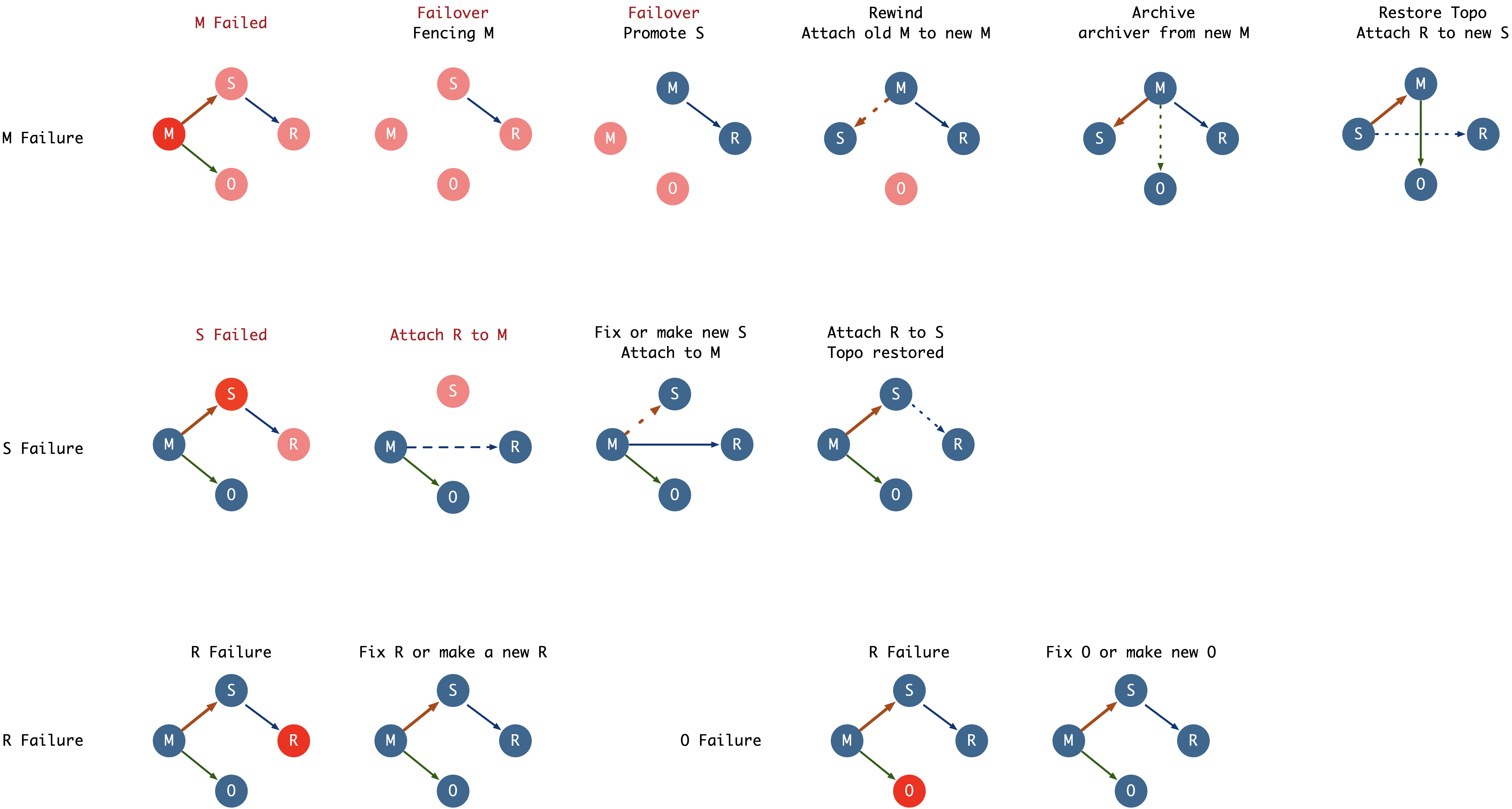
When M fails, it affects all components. Failover must be executed to promote S to the new M to restore the system as quickly as possible. Manual failover includes two steps: Fencing M (from heavy to light: shutdown, stop database, change HBA, close connection pool, pause connection pool) and Promote S. Both operations can be completed in a very short time through scripts. After failover, the system is basically restored. The original topology structure needs to be restored afterwards. For example, convert the original M to a new replica through pg_rewind, attach O to the new M, attach R to the new S; or after repairing M, return to the original topology through planned failover.
When S fails, it directly affects R. As a hotfix, we can change R’s replication source from S to M to fix R’s impact. Meanwhile, redistribute S’s original traffic to other replicas or M through connection pool redirection, then we can slowly investigate and fix issues on S.
When O and R fail, since they have neither significant direct impact nor direct descendants, simply recreating them is sufficient.
Implementation
PostgreSQL Testing Environment provides a sample 3-node cluster containing M, S, O nodes. R node is a type of S, so it’s omitted here.
Here, the primary directly attaches two “replicas”: one is the S node, and the other is the WAL log archiver on the O node. In cases with very low data loss tolerance, both can be configured as synchronous replicas.