
504 Extensions: Expand the PostgreSQL Landscape

A GitHub issue turned into an extension sprint. 32 new additions say a lot about where PostgreSQL is headed.
It Started with a Chemistry Extension
Two days ago, a user opened a GitHub issue: he was using RDKit, the de facto standard library in cheminformatics, to store molecular structures, run substructure searches, and compute similarity inside PostgreSQL. He noticed that the official PGDG package was built without InChI support. After spending a while rebuilding it with the right compile flags, he got it working, but still hoped Pigsty could support it out of the box.
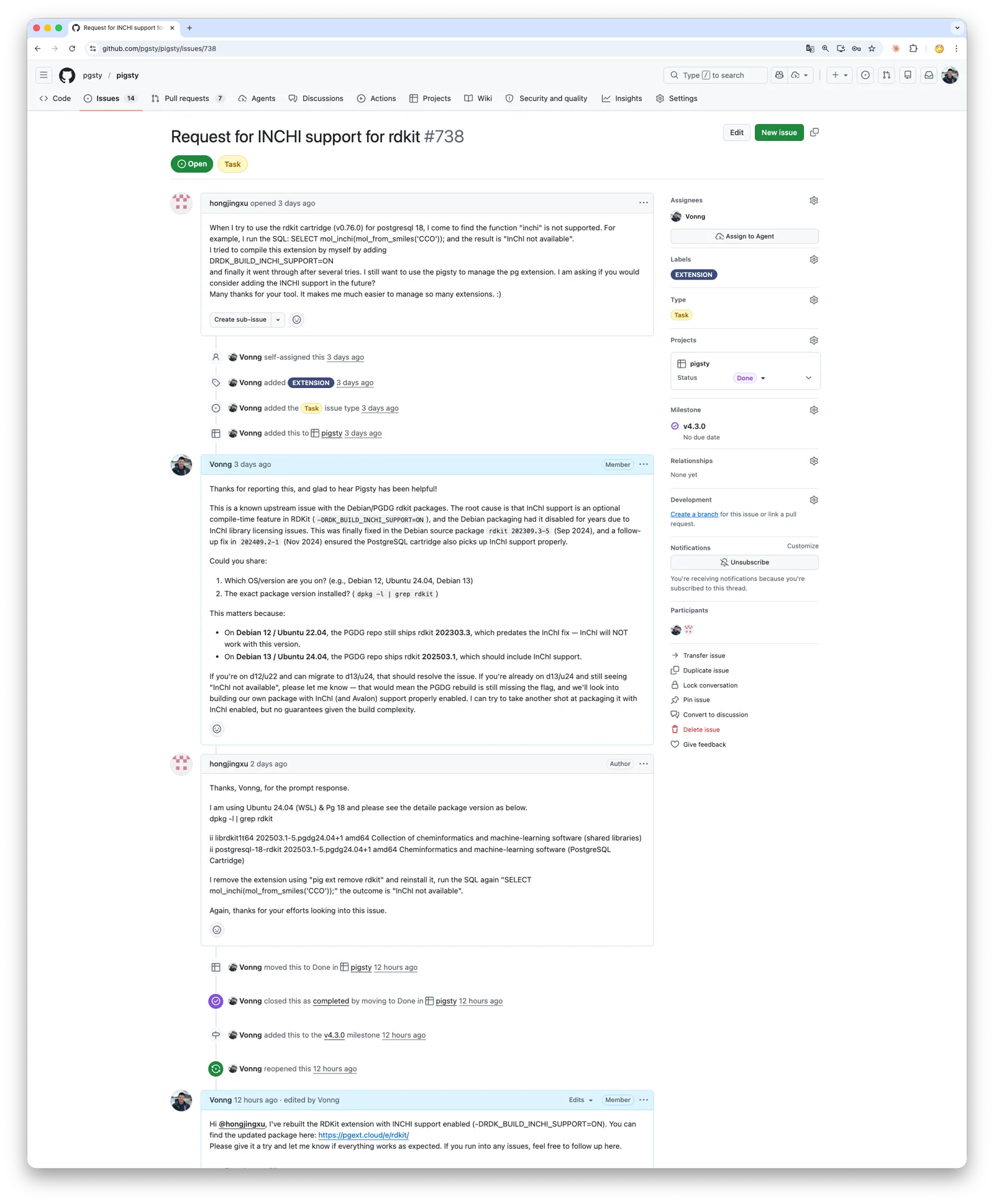
RDKit really is a nasty one. I tried to bring it into the Pigsty extension repo about two years ago, porting it from Debian to EL. The dependency tree was ugly: Boost, Eigen, RapidJSON, Cairo, plus optional modules like InChI and Avalon. Each one came with its own build flags and OS-specific library-version problems. I fought with it for a while, got nowhere, and shelved it.
This time was different. I had coding agents.
Using Codex or Claude Code for this kind of build-system archaeology is almost unfair. Things that used to take endless rounds of trial and error now usually take one or two iterations of prompting and then waiting. This release also fixed the missing InChI support in the PGDG package. In practice it came down to enabling one more build flag and bundling the InChI source. It worked on the first proper pass, and the user was happy.
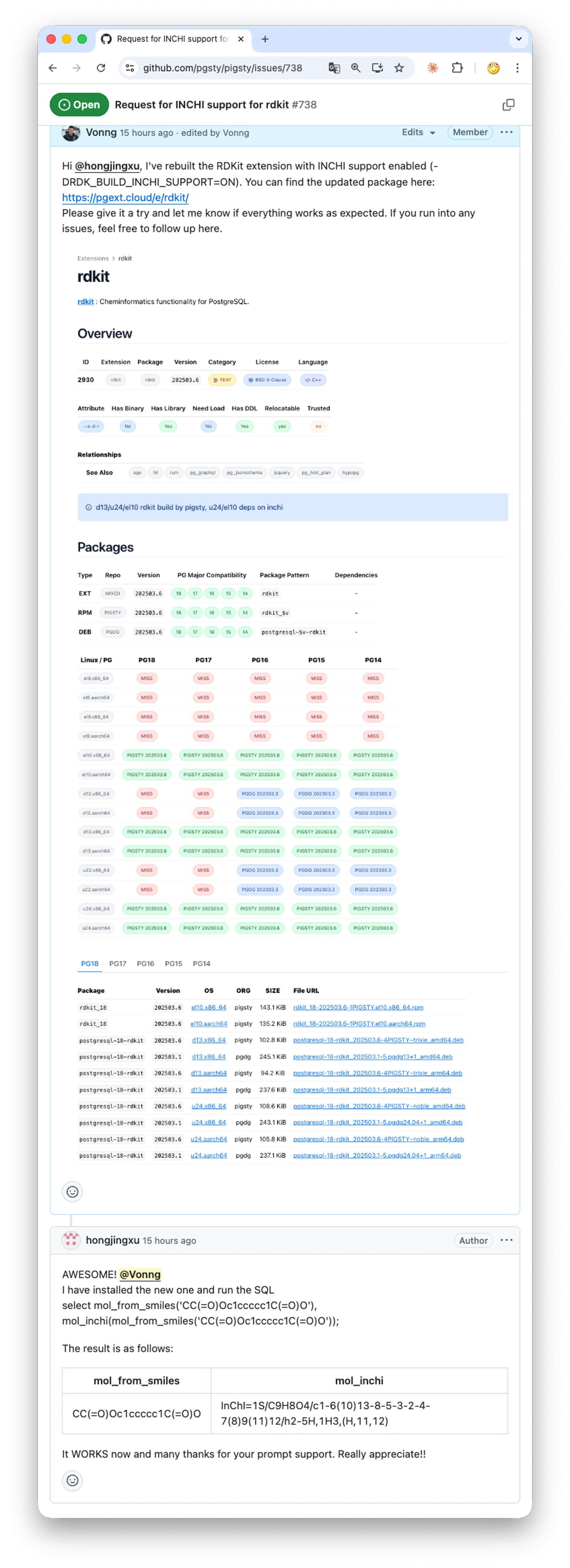
Honestly, feedback like that is the best part of doing open source.
Strike While the Iron Is Hot
Once I was warmed up, I went after a few other long-standing problem cases.
plv8: PostgreSQL bindings for the V8 engine. It had refused to build on EL10 for a while. This time, after carrying a few patches, I finally got it building reliably.
duckdb_fdw: lets PostgreSQL read and write external DuckDB files. Previously it clashed with DuckDB’s official pg_duckdb extension because both wanted the same shared library name, so I had to hide it temporarily. This time I turned duckdb_fdw into a sub-extension of pg_duckdb, so they share the same libduckdb. The conflict is gone, and both can coexist cleanly again.
At that point I figured: if the toolchain is already hot, why not finish the rest of the worthwhile extensions in the PostgreSQL ecosystem that had been sitting on the backlog? That turned into this release: 32 new additions, 22 updates, and the Pigsty extension repo officially crossing 500, landing at 504 total extensions.
| Category | All | PGDG | PIGSTY | CONTRIB | MISS | PG18 | PG17 | PG16 | PG15 | PG14 |
|---|---|---|---|---|---|---|---|---|---|---|
| Total | 504 | 155 | 332 | 71 | 0 | 481 | 488 | 479 | 473 | 457 |
| EL | 499 | 150 | 332 | 71 | 5 | 472 | 482 | 474 | 468 | 452 |
| Debian | 489 | 107 | 311 | 71 | 15 | 466 | 474 | 464 | 458 | 442 |
Out of these 500-odd extensions, around 70 ship with PostgreSQL itself, roughly 150 are packaged by PGDG, and the remaining 330 are third-party extensions that I package and maintain myself.
To put that in perspective: most managed PostgreSQL cloud RDS expose a few dozen extensions at best. Take Supabase, for example. It looks like a long list, but after you subtract the 35 contrib extensions that come with PostgreSQL, you are left with fewer than 30 third-party extensions.
The New Extensions
This batch is heavy. Broadly, four groups:
Data-domain extensions: make chemical molecules, RDF triples, BSON, Protobuf, recurring schedules, and other complex objects first-class database citizens.
Query extensions: sparse linear algebra and graph algorithms, Datalog-style graph queries, full-text search, hybrid ranking fusion, recursive SQL template engines.
Production engineering extensions: deep observability, exported query telemetry, CDC to MQTT, COPY interception, DDL propagation for logical replication, lightweight distributed locks, soft-alert data quality management.
Developer-experience extensions: session variables, pseudo-autonomous transaction logging, natural-language time parsing.
Together they point to a broader trend: the extension layer is pushing PostgreSQL into the space between an application platform and a data platform. Things that used to require separate services increasingly fit inside a single SQL transaction boundary.
A Tour of the New Additions
This release adds 32 new extensions. The summaries below were compiled with help from Claude, Codex, and Gemini to give readers a quick way to understand what each one does, how it works, and where it fits.
1. rdkit: Cheminformatics Inside PostgreSQL
RDKit is the de facto standard open-source cheminformatics library, started by Greg Landrum (originally at Novartis, now T5 Informatics). Its PostgreSQL cartridge brings molecular storage, substructure search, and similarity computation into a relational database — millions of compounds queryable with plain SQL.
The cartridge adds mol (molecules) and qmol (SMARTS query patterns), plus bfp/sfp fingerprint types. Operators: @> for substructure matching, % for Tanimoto similarity, <%> as a distance operator — all GiST-indexable via fingerprint pre-filtering. Key functions: mol_from_smiles(), morganbv_fp(), tanimoto_sml(). GUCs like rdkit.tanimoto_threshold control match sensitivity.
Using the ChEMBL dataset with 1.87 million compounds as an example:
Use cases center on drug discovery: lead scaffold search across million-scale libraries, SAR analysis via similarity, compound registration with fingerprint dedup, and catalog search over datasets like eMolecules (6M+ compounds).
Settle your index strategy and query templates early — filters that are correct but bypass indexes will be slow. On 1.87M compounds, substructure queries range from ~88 ms to ~1.9 s; with tuning, the cartridge handles 6M+ compounds. BSD licensed. Docker images (mcs07/postgres-rdkit) and conda packages available.
2. provsql: Semiring Provenance for Query Results
ProvSQL, from Pierre Senellart (ENS Paris / INRIA Valda, VLDB 2018), adds (m-)semiring provenance and uncertainty management to PostgreSQL. It tracks which base tuples each query result was derived from, and lets you evaluate that provenance under different algebraic structures: booleans, security levels, counts, or probabilities.
It hooks into query execution and adds a hidden provsql UUID column to each table, pointing into a provenance circuit. Supported SQL is broad: SELECT-FROM-WHERE, JOIN, GROUP BY, DISTINCT, UNION/EXCEPT, aggregates, HAVING, and on PG 14+ also INSERT/DELETE/UPDATE. Core functions: add_provenance(), provenance_evaluate(), formula(), probability_evaluate(). Probability evaluation ranges from naive to Monte Carlo to d-DNNF compilation via external solvers (d4, c2d).
Four typical scenarios: security-label propagation (results inherit the highest source classification), probabilistic databases (base tuples carry confidence scores), data lineage and audit (trace each output row back to sources, optionally export as PROV-XML), and credibility scoring (e.g. weighting witness statements in investigative workflows).
The key property is composability: provenance is not a dead log string but a live object you can keep computing on. Worth enabling on critical paths — core reports, feature pipelines, compliance calculations — not as a blanket switch for the whole database. C/C++ with Boost; provenance circuits live in shared memory. PG 10–18. MIT.
3. onesparse: Billion-Edge Graph Algorithms in SQL
OneSparse wraps SuiteSparse:GraphBLAS to bring high-performance sparse linear algebra into PostgreSQL. Developer Michel Pelletier sits on the GraphBLAS C API committee; advisor Timothy A. Davis is the SuiteSparse author. The premise: represent graphs as sparse matrices and run BFS, PageRank, triangle centrality, and friends via matrix operations — all from SQL.
Types: matrix, vector, scalar, semiring, monoid. Operator @ for matrix multiplication under plus_times semiring. Ships LAGraph algorithms: BFS (level and parent modes), PageRank, triangle centrality, degree centrality, SSSP. Wraps GraphBLAS opaque handles in PostgreSQL’s Expanded Object Header; small graphs (<1 GB) in TOAST, larger ones as Large Objects or files. Built-in JIT with NVIDIA CUDA GPU acceleration.
On the GAP benchmark, BFS over a 4.3 billion-edge graph reached 70 billion+ traversed edges per second (48-core AMD EPYC). Targets: fraud detection on transaction graphs, social-network analysis, Graph RAG. The usual caveat applies: real usability depends on whether your load/serialization formats and the SQL planner play nicely end-to-end. Start small.
Requires PG 18 Beta or newer; still alpha. Apache 2.0.
4. pg_datasentinel: Deep Observability for PostgreSQL in the Container Era
pg_datasentinel (Christophe Reveillere / Datasentinel, 1.0 released April 10 2026) fills four gaps in PostgreSQL’s native monitoring, especially for containerized deployments:
- Extended activity monitoring — augments
pg_stat_activitywith per-backend memory usage, live temp-file bytes, and on PG 18+ the current plan ID. - Container resource visibility — CPU quotas, memory limits/usage, and CPU pressure for Docker / Kubernetes / OpenShift / any cgroup environment.
- Transaction wraparound forecasting — tracks XID and MXID burn rate, exposes live ETAs to aggressive vacuum and wraparound limits.
- Log capture views — parses vacuum, analyze, temp-file, and checkpoint events into a shared-memory ring buffer queryable from SQL.
For PostgreSQL on Kubernetes, this gives container-level visibility without a separate monitoring agent. The XID wraparound warning is the standout — wraparound can force-shutdown a database, and having a burn-rate ETA turns firefighting into forecasting. 3-Clause BSD. PG 15+.
5. datasketches: Approximate Analytics at Hundred-Million-Row Scale
Apache DataSketches (Apache Foundation, originally Yahoo/Verizon Media) brings approximate query data structures into SQL. When exact COUNT(DISTINCT), quantiles, or heavy-hitter analysis gets too expensive on large datasets, sketches trade a few percent of accuracy for orders of magnitude in speed and memory.
Seven sketch types: cpc_sketch (compressed probabilistic counting), hll_sketch (HyperLogLog), theta_sketch (distinct counting with set algebra), aod_sketch (tuples), kll_float_sketch/kll_double_sketch (quantiles), req_float_sketch (tail quantiles), frequent_strings_sketch (frequent items). Standard API: *_sketch_build(), *_sketch_union(), *_sketch_get_estimate().
What makes sketches powerful is mergeability: pre-aggregate by dimension slice, union at query time for arbitrary distinct counts. Sublinear memory. Binary format compatible across Java, C++, Python, Rust, and Go.
Use cases: real-time UV counting without storing user IDs, latency distribution (p50/p95/p99 over billions of events), audience overlap via Theta Sketch intersections (“saw ad A and visited site B”). On 100M rows, CPC distinct counting takes ~20 s vs ~2 min for exact COUNT(DISTINCT), with single-digit percent relative error.
6. pghydro: Drainage-Network Analysis from Brazil’s National Water Agency
PgHydro, by Alexandre de Amorim Teixeira (Brazil’s National Water and Sanitation Agency, ANA), is ANA’s official tool for hydrology workflows nationwide. Built on PostGIS, presented at FOSS4G 2022.
It covers the full hydrological network workflow: GIS data import, topological consistency checks, flow direction, Otto Pfafstetter basin coding, upstream/downstream analysis, catchment area, and Strahler stream order. Five sub-extensions: pghydro (core), pgh_raster (DEM), pgh_hgm (hydrogeomorphology), pgh_consistency (validation), pgh_output (export).
Fits national-scale hydrology databases, basin planning, upstream/downstream pollution analysis, and drainage-network validation. Think of it less as “an extension with GIS functions” and more as a domain-specific ETL pipeline living inside the database — raw terrain and river data in PostGIS, processing automated in SQL, recomputation after source updates far more reliable than ad hoc scripts. QGIS plugin PgHydroTools available for visual interaction. Pure PL/pgSQL. GPLv2.
7. pg_stat_ch: PostgreSQL Query Telemetry, Exported to ClickHouse
pg_stat_ch comes from ClickHouse itself (February 2025 “Postgres Week at ClickHouse”, author Kaushik Iska). Where pg_stat_statements aggregates inside PostgreSQL, pg_stat_ch streams every raw query execution event (45 fields, fixed 4.6 KB each) out to ClickHouse for p50/p95/p99 analysis, top-query ranking, and error analytics.
Pipeline: PG hooks → shared-memory ring buffer → background worker → ClickHouse via native binary protocol with LZ4 compression (statically linked clickhouse-cpp). The 45 fields cover timing, row counts, buffers, WAL, CPU, JIT (PG 15+), parallel workers (PG 18+), client context, and SQLSTATE errors. On queue overflow it drops events and bumps a counter rather than applying backpressure — StatsD philosophy.
On the ClickHouse side it ships four materialized views: events_recent_1h for a rolling one-hour copy, query_stats_5m for five-minute buckets with TDigest quantiles, db_app_user_1m for database/app/user load attribution, and errors_recent for a rolling seven-day error window.
Performance: ~5 μs p99 overhead per query. pgbench at 36.6K TPS / 32 clients captured 7.7M events in 30 s with zero drops and <1% TPS impact. Lock contention minimized in three layers: atomic overflow checks → non-blocking LWLock → per-backend local buffers flushed per transaction (~5x fewer lock acquisitions). A clean division of labor: PostgreSQL for transactions, ClickHouse for telemetry. Far more robust than reconstructing the same picture from log files. PG 16–18. Apache 2.0.
8. pg_rrf: Rank Fusion for Hybrid Search in One Function
pg_rrf (yuiseki, January 2026, Rust/pgrx) packages Reciprocal Rank Fusion (RRF) as a native PostgreSQL function. In hybrid retrieval, different retrievers produce scores on incomparable scales. RRF sidesteps that by using rank positions only:
score(d) = Σ 1 / (k + rank_i(d))
The default k is 60, following Cormack et al., SIGIR 2009.
The extension exposes four functions: rrf(rank_a, rank_b, k) for two-way fusion, rrf3() for three-way fusion, rrfn(ranks[], k) for N-way fusion, and the most useful one in practice, rrf_fuse(ids_a bigint[], ids_b bigint[], k), which takes two ranked ID arrays and returns a fused (id, score) table. It is NULL-safe: an ID that appears in only one list is scored from that list alone.
Replaces 20+ lines of FULL OUTER JOIN / COALESCE / hand-rolled score math with one function call. Good fit for RAG hybrid retrieval, product search, and multi-signal document ranking. Keeping fusion in the database helps when the fused result still needs to join business tables. v0.0.3. MIT.
9. pg_kazsearch: Kazakh Full-Text Search, from Zero to One
pg_kazsearch is the first PostgreSQL full-text-search extension for Kazakh. Kazakh is highly agglutinative — a single word like мектептерімізде stacks plurality, possession, and locative suffixes atop the root мектеп. Existing PG and Elasticsearch analyzers cannot handle this.
Written in Rust/pgrx. Provides kazakh_cfg text-search config and pg_kazsearch_dict. Stemming uses BFS suffix stripping with vowel-harmony validation and a 21,863-root POS-tagged lexicon (Apertium-kaz) to prevent over-stemming. Tunable via ALTER TEXT SEARCH DICTIONARY.
Benchmarks on 2,999 articles: 0.5 ms query latency (2.8x faster than pg_trgm), +25% nDCG@10, +23% Recall@10. Useful for Kazakh news/government-document search, e-commerce, and multilingual systems that need proper search for low-resource languages instead of crude trigram fallback.
10. pg_liquid: Datalog-Style Graph Queries
pg_liquid (Michael Golfi) brings Liquid/Datalog-style declarative graph queries into PostgreSQL. liquid.query(...) lets you declare facts, define rules, and run a terminal query in one call — no separate graph database needed. Rules are scoped to a single invocation. Supports fact assertions, recursive transitive closure, compound queries, and row normalizers.
Also supports ontology predicates (DefPred) and typed compounds (OntologyClaim@(...)), where compounds carry provenance or confidence while rules handle subclass closure. Good fit for knowledge-graph queries, hierarchy traversal (org charts, taxonomy trees), and rule-based business logic. Pure PL/pgSQL, no external dependencies. Early-stage.
11. logical_ddl: Logical Replication, but for DDL Too
PostgreSQL logical replication handles DML only — no DDL. Schema drift breaks replication. logical_ddl (Samed Yildirim) fills that gap with event triggers that intercept DDL, deparse it into a replicated table, and generate equivalent SQL on the subscriber side.
Supported: ALTER TABLE RENAME TO, RENAME COLUMN, ADD COLUMN, ALTER COLUMN TYPE, DROP COLUMN. Built-in types, arrays, composites, domains, and enums work; CREATE TYPE itself is out of scope. logical_ddl.publish_tablelist controls capture per table and per command type.
Useful for automated DDL sync in logical-replication setups, zero-downtime migrations, and multi-datacenter topologies. DDL propagation becomes an auditable data flow rather than a manual side process. MIT. PGXN available. Constraints, indexes, and defaults not yet supported.
12. rdf_fdw: Query the Semantic Web with SQL
rdf_fdw (Jim Jones) is a foreign data wrapper that bridges SQL and the semantic web by querying RDF triple stores via SPARQL endpoints. Adds an rdfnode type for IRIs, language tags, and typed literals. Supports SQL-to-SPARQL pushdown for WHERE/LIMIT/ORDER BY/DISTINCT, plus INSERT/UPDATE/DELETE via SPARQL UPDATE endpoints.
rdf_fdw_clone_table() can batch-clone foreign data into local tables. Watch memory: fetched data is loaded before conversion, so large result sets need effective pushdown. Good for linked-data integration (DBpedia, Wikidata) and using SQL/BI tooling on SPARQL endpoints. MIT. PG 9.5–18.
13. pgbson: A More Exact Binary Document Type than JSONB
pgbson (buzzm, a.k.a. postgresbson) adds a native BSON type to PostgreSQL. BSON provides first-class datetime, decimal128, int32/int64, binary, etc. — types that matter for exact round-tripping across distributed systems. Binary-perfect BSON in, BSON out.
Two access styles. Fast path: dotpath functions like bson_get_string(bson, 'd.recordId'), bson_get_datetime(), bson_get_decimal128() — walk the binary directly, allocate only at the leaf. Slow path: -> / ->> operators that construct intermediate subdocuments at each level. Expression indexes on the function API can yield 10,000x speedups over sequential scan. Also accepts EJSON input.
Use cases: cross-language event pipelines needing exact type preservation, financial data (decimal128), and digital-signature workflows relying on deterministic binary representation. MIT. PG 14–18.
14. pg_when: Describe Time in Natural Language
pg_when (frectonz) parses natural-language time expressions into timestamptz or Unix epochs. when_is(text) returns a normalized timestamp; grammar: date + at + time + in + timezone, defaulting to UTC.
Also: seconds_at(), millis_at(), micros_at(), nanos_at() for Unix epochs at varying precision. A parser, not a scheduler. Fits operator-facing tools that accept human time input, backfill scripts where natural language beats date math, and timezone normalization. MIT.
15. pgmqtt: Push Database Changes Straight to MQTT
pgmqtt (RayElg, Rust) turns PostgreSQL row changes into MQTT messages and maps inbound MQTT messages back into tables. Not a general MQTT client — it wires database CDC to a message broker at the database layer, with SQL-defined topic mappings and payload templates.
Natural fit for IoT: push database state changes to edge devices without middleware, or ingest sensor readings from MQTT directly into tables. Also works for lightweight event-driven systems that want less glue code. Elastic License 2.0.
16. pg_query_rewrite: Transparent SQL Substitution
pg_query_rewrite (Pierre Forstmann) uses the ProcessUtility hook to transparently replace SQL statements at runtime. Rules live in shared memory, matched by exact string equality — whitespace and case both matter.
A sharp tool with sharp edges: no parameterized statements, max ~32 KB per statement, matching is whitespace/case/semicolon-sensitive, rules do not survive restarts unless reloaded via startup SQL. Still useful for redirecting fixed SQL from legacy systems during migrations, intercepting dangerous queries, and simple query A/B tests. Default max 10 rules. PG 9.5–18.
17. pgclone: Clone Database Objects with One Function Call
pgclone (valehdba, v2.0.0 on PGXN) lets you clone tables, schemas, databases, functions, roles, and privileges from a source instance via SQL functions — no pg_dump/pg_restore or shell scripts needed.
Uses the COPY protocol for fast data movement. Supports async operation with progress tracking, row/column filters, DDL coverage (indexes, constraints, triggers, views, materialized views, sequences), masking, and automatic sensitive-column discovery.
Good for fast dev/test provisioning, sanitized prod-to-staging clones, and cross-database migration — the whole workflow stays inside the database.
18. pgproto: Native Protobuf Support
pgproto (Apaezmx) adds native Protocol Buffers (proto3) storage, query, mutation, and indexing. Register a FileDescriptorSet in pb_schemas, then protobuf columns expose nested fields via path arrays. Operators: -> field navigation, #> nested path, || message merge. Functions: pb_set(), pb_insert(), pb_delete(), pb_to_json().
100K-row benchmark: 16 MB storage (vs 46 MB JSONB, 25 MB relational), 5.9 ms full-document retrieval (vs 33.1 ms relational with multi-table joins). If you want to keep Protobuf for RPC/messaging while making the data indexable inside the database, this delivers. Fits IoT data, microservice event stores, gRPC data layers. PostgreSQL License.
19. pg_fsql: A Recursive SQL Template Engine Driven by JSONB
pg_fsql (yurc) is a recursive SQL template engine driven by JSONB. Templates are organized as dot-path trees; child templates emit fragments or JSON injected into parents. Placeholder syntax: {d[key]} with escaping modes (!r, !j, !i). Command types: exec, ref, if, exec_tpl, map, NULL. Optional SPI plan caching per template. APIs: fsql.run (execute), fsql.render (dry run), fsql.tree, fsql.explain. No superuser needed.
Not “functional SQL” — more a hierarchical template system for generating SQL from JSON request bodies. Reduces conditional branching in the application layer. Fits dynamic reports, ETL orchestration, multi-tenant query generation, and centralized SQL templates stored in tables.
20. pg_dispatch: Async SQL Dispatch on Top of pg_cron
pg_dispatch (Snehil Shah) is an async SQL dispatcher built on pg_cron, TLE-compatible alternative to pg_later. pgdispatch.fire(command) for immediate async execution, pgdispatch.snooze(command, delay) for delayed. The point: get heavy work out of the foreground transaction — if an AFTER INSERT trigger needs something expensive, push it to the background.
Pure PL/pgSQL, runs in sandboxed environments (Supabase, AWS RDS). Requires pg_cron >= 1.5. Good for async side effects in triggers/functions — notifications, background rollups, audit writes that should not block the main transaction.
21. block_copy_command: Security Hardening by Intercepting COPY
block_copy_command (rustwizard, Rust/pgrx) intercepts COPY cluster-wide via ProcessUtility hook. In PCI-DSS or HIPAA environments: block exfiltration via COPY TO, block unauthorized imports via COPY FROM.
Role-based blocklists, directional control (block_to / block_from), COPY ... TO PROGRAM blocked for everyone by default. Blocklist can include superusers. Built-in audit logging.
Useful in multi-tenant or hosted environments, enterprise compliance setups needing centralized audit, and ETL environments where import/export privileges must be tightly separated. The author also maintains a broader command-firewall extension, pg_command_fw.
22. pg_isok: Soft Alerts for Data Quality
pg_isok (Karl O. Pinc, in production for 10+ years) is soft-trigger data integrity management. You write SQL queries that find suspicious data patterns; Isok records, classifies, and defers findings, surfacing only newly introduced problems or changes to previously accepted data — no re-reviewing the same historical anomalies.
Unlike hard constraints, Isok lets questionable data exist while keeping it under review. Workflow: isok_queries and isok_results tables, run_isok_queries to execute checks; results accepted or deferred row by row. Fits messy-data cleanup and business rules too fuzzy for hard constraints that still need human judgment.
23. external_file: Oracle BFILE Semantics for PostgreSQL
external_file (Gilles Darold, HexaCluster Corp) provides Oracle BFILE equivalence. EFILE type references server-side files via directory alias + filename; readEfile(), writeEfile(), copyEfile() for I/O. Built on lo_* large-object machinery with directory-alias and privilege tables controlling access.
Built for Ora2Pg migrations, but also useful for legacy systems with files outside the database and metadata inside, or database-driven batch import/export of external large objects.
24. byteamagic: Detect File Types in bytea
byteamagic (Nico Mandery) wraps libmagic (the library behind Unix file). Two functions: byteamagic_mime(bytea) returns MIME type, byteamagic_text(bytea) returns human-readable description.
If you store BLOBs in tables, this identifies what they actually are from SQL. Good for upload governance, real content-type detection, and historical BLOB cleanup.
25. pg_text_semver: Native Semantic Versioning
pg_text_semver (Rowan Rodrik van der Molen) implements SemVer 2.0.0 as a text domain. Unlike the C-based semver extension, version components have no 32-bit integer limit.
Pure SQL. Supports min/max aggregation and PGXN version-range validation. Useful for extension/package version management, dependency checks, and version analytics.
26. parray_gin: Substring Matching Indexes for text[]
parray_gin (Eugene Seliverstov) adds partial-match operators for text[] columns backed by GIN indexes. Native GIN array operators only do exact element matching; parray_gin adds @@> for substring containment, using pg_trgm trigram decomposition with recheck for false positives.
Useful for tag autocomplete, fuzzy tag search, or any case where array partial matching should hit an index. PG 9.1–18.
27. pg_slug_gen: Cryptographically Secure Timestamp Slugs
pg_slug_gen (Fernando Olle) generates short unique identifiers combining timestamp info with cryptographically secure randomness (pg_strong_random()). Length sets precision: 10 chars (seconds), 13 (milliseconds), 16 (microseconds, default), 19 (nanoseconds).
Not a “slugify the title” URL helper — a short, hard-to-guess public identifier. Good for invite codes, short links, and public resource IDs where exposing auto-increment sequences is undesirable. Much less predictable than base62(sequence).
28. pglock: Lightweight Distributed Locks Inside PostgreSQL
pglock (fraruiz) implements lightweight distributed locks on top of PostgreSQL. Lock table + functions: pglock.lock, pglock.unlock, pglock.ttl, pglock.set_serializable. TTL expiration (default 5 min), optionally reaped by pg_cron. Recommended isolation: SERIALIZABLE.
No Redis or ZooKeeper needed. Fits multi-instance job competition, leader election, idempotent consumers, duplicate-work prevention — lock behavior and business writes stay in the same database. Pure SQL.
29. pg_regresql: Portable Planner Statistics for EXPLAIN Costing
pg_regresql (Radim Marek / boringSQL) solves a specific plan-regression-testing problem: the planner reads real file sizes from disk and scales row counts accordingly, so injected production-sized statistics in pg_class get overridden by your tiny CI dataset’s physical size.
The extension hooks get_relation_info_hook to force the planner to trust pg_class values (relpages, reltuples, relallvisible) instead of physical file sizes. This makes cost estimates portable — compare EXPLAIN output across schema versions, reproduce production plans on a laptop, keep plan baselines stable in CI.
Only affects planner costing, not execution or EXPLAIN ANALYZE actuals. For test/CI only, not production. BSD 2-Clause.
30. pgcalendar: Infinite Projection for Recurring Schedules
pgcalendar (h4kbas) implements a full recurring-event calendar. Events are logical entities; schedules define recurrence (daily/weekly/monthly/yearly); projections generate concrete occurrences; exceptions cancel or reschedule individual instances.
Infinite projection, schedule transitions, and exception handling show up everywhere — rostering, meetings, billing — and become a mess when every application reimplements them. Putting this in the database centralizes permissions, audit, and consistency.
31. pg_variables: Session Variables Faster than Temp Tables
pg_variables (Postgres Professional) adds session-level variables — scalars, arrays, and records — grouped into named packages. By default variables do not roll back; with is_transactional = true they honor ROLLBACK and SAVEPOINTs.
A high-performance temp-table alternative that avoids catalog bloat. Useful for intermediate state in stored procedures/batch jobs, connection-level caching, and as infrastructure for other extensions (pgelog uses it to cache dblink connections).
32. pgelog: Logs That Survive Rollback
pgelog (anfiau) uses dblink to simulate pseudo-autonomous transactions — log records survive even when the calling transaction rolls back. Solves a classic PL/pgSQL problem: logs written inside an EXCEPTION block disappear when the outer transaction aborts. Uses pg_variables to cache dblink connections per session.
On critical paths, losing the diagnostic trail because the business transaction rolled back is exactly the wrong outcome. Also makes staged batch/migration scripts easier to introspect than RAISE NOTICE. Depends on dblink and pg_variables; each session may open an extra connection, so mind max_connections.
Conclusion
These 32 additions trace a few clear lines.
More “professional objects” inside the database. BSON, Protobuf, RDF, recurring schedules, molecules, graphs — the database becomes a queryable store for complex domain objects, with permissions, audit, backup, and transactions already built in. Less data movement, fewer sidecar services.
Query capabilities as composable APIs. RRF fusion, recursive SQL templates, query rewriting, sparse algebra, sketch approximations — more logic expressed in fewer, more stable SQL building blocks, auditable and optimizable.
The extension layer absorbing platform and ops work. Telemetry export (pg_stat_ch), container visibility (pg_datasentinel), security hooks (block_copy_command), soft-alert governance (pg_isok) — capabilities that used to live outside the database are being pulled in.
Deeper vertical penetration. Cheminformatics (rdkit), hydrology (pghydro), Kazakh NLP (pg_kazsearch) — PostgreSQL keeps becoming the computational substrate for more specialized fields.
Cathedrals (Apache Foundation projects) and bazaars (weekend builds) side by side, building the most advanced open-source database ecosystem in the world.