
An Ice Cream Agenda

I
On September 12, a celebrity who made his name campaigning for consumer rights ate some ice cream at an airport. He didn’t like it and posted on Weibo.
In parentheses, he added seven Chinese characters: Please, don’t mess with me.
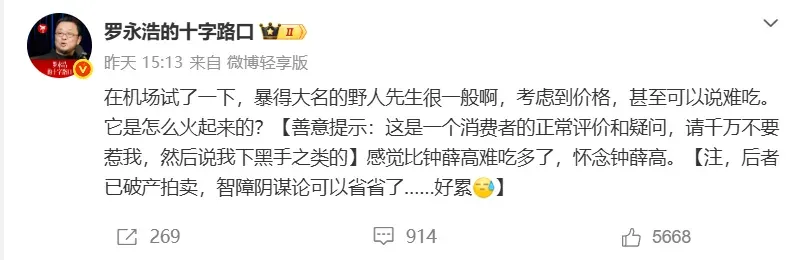
An ordinary consumer who eats something awful and vents on Weibo doesn’t need to warn the company in advance not to hit back. He doesn’t even matter enough to warrant a response: he rants, the company keeps selling, and it probably never even sees his post.
Someone who opens with “don’t mess with me” knows exactly what power he holds.
II
He says this is a normal consumer review.
The whole maneuver hinges on that sentence. Let’s take it apart.
The law and common sense give the words “tastes awful” extraordinary immunity: no need to offer evidence, no need for verification, no need to take responsibility. Why? Because an ordinary person saying “tastes awful” can’t destroy anyone. This is a protective exemption for the weak. That immunity costs little because the words carry no weight.
But when the same words come from someone who can put them on trending lists across the internet, the act itself is materially different.
The ice cream chain has more than 1,700 stores across 30 provinces, yet it didn’t dare respond with a single word on any platform. Trending headlines described its approach as “letting it blow over,” while people in the comments kept instructing the brand: do not reply, do not reply. The last company that ignored that advice answered a Weibo post from the same celebrity last September. Four months later, it closed 102 stores at once.
This isn’t expression. It’s allocation—allocation of the country’s finite supply of public attention for the week.
There is an old saying in communication studies: the media may not be able to tell you what to think, but they are exceptionally good at telling you what to think about. That power has a name: agenda setting.
So “I’m just a consumer” translates as: I borrow the immunity of the weak to exercise the power of the strong.
III
Agenda setting has three layers.
First, deciding what gets discussed. Making the country talk about ice cream this week.
Second, deciding how it gets discussed. What follows that same verdict of “tastes awful”? This: “I think it tastes far worse than Zhong Xue Gao. I miss Zhong Xue Gao.” So everyone talking about ice cream this week automatically has two reference points in mind: one tastes awful; the other is remembered fondly.
Third, deciding what doesn’t get discussed. Attention is zero-sum, and the trending lists have only so many slots. This week’s public attention went to a serving of ice cream. What got left out? No one knows, because those issues never made the list.
The true shape of agenda-setting power lies not in what it says, but in the issues it passed over—the ones no one talks about this week as a result. And the selection criterion is never importance; it’s shareability. A serving of ice cream makes the cut because it’s tangible, vivid, and everyone can imagine taking that bite.
IV
Now let’s lay out a timeline.
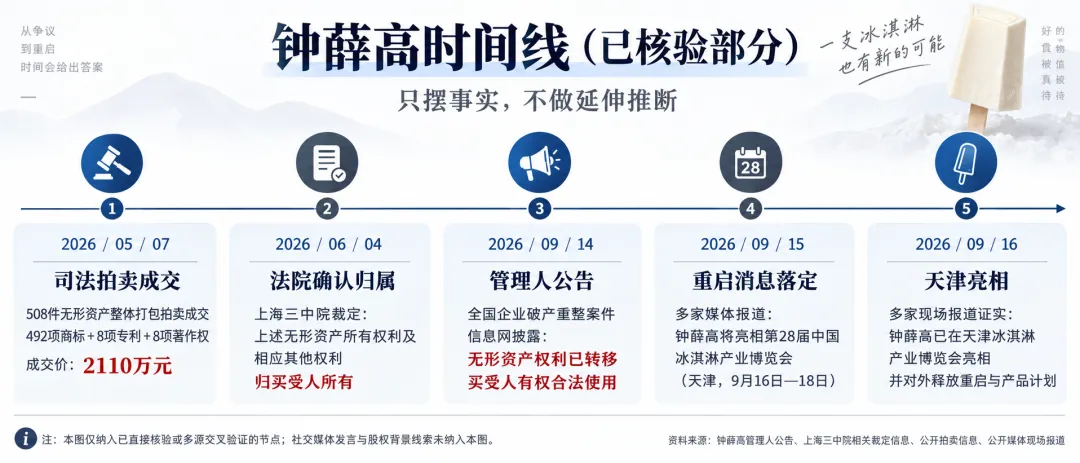
One financial news outlet put it very cautiously: it was unclear whether this was a coincidence or something else.
I don’t know either. I’m even willing to believe it was a coincidence—someone misses a brand, and that brand happens to come back to life. These things happen.
But pay attention to those parentheses. On September 12, before anyone had raised a question, he had already drafted a rebuttal to a conspiracy theory that did not yet exist: the latter had gone bankrupt and been auctioned off. That statement is literally true. Yet when he wrote it, the trademarks had been in new hands for three months, the new company had been registered, and the relaunch announcement was three days away.

Did he know? I don’t know. That is precisely the problem.
A consumer’s motives don’t need auditing, because no one cares why he says something tastes awful. An agenda-setter’s motives must be open to audit, because they determine what 1.4 billion people think about that week. When he demotes himself to a consumer, he also demotes his motives from a matter of public concern to a private affair.
That is the real payoff from this sleight of hand. It shields him not from responsibility, but from being questioned.
V
My day job is building a database distribution. Writing online doesn’t even qualify as a side job, though I do have some influence in the database and cloud computing world. So I know how agenda setting works. I set agendas too: Are cloud databases an idiot tax? Is cloud computing a pig-butchering scam? Are Big Tech companies just amateur outfits? I wrote those headlines, and I know what they do.
But I freely acknowledge this. I won’t criticize cloud vendors while claiming to be just a user. The very function of “I’m just a consumer” is to make that sort of challenge impossible—you can’t very well demand that a consumer produce evidence for his taste.
VI
So the question has never been whether he can say it tastes awful. Of course he can.
The issue is this: You can set the agenda. But you cannot set the agenda while claiming you’re only eating ice cream.
Agenda setting is a form of power. Setting the agenda is not the problem. This power cannot be abolished, nor should it be: where every front door has been welded shut, it’s the only lever that can still pry something open. Last year’s controversy forced the release of a draft national standard for premade meals. That is a fact.
Power may go unchecked, but it at least has to admit it is power.
This week’s ice cream agenda has already been set: one tastes awful, one is remembered fondly, and one appears at an expo today. As for the things we should have discussed this week but didn’t—sorry, all the slots are taken.
VII
Disclosure: I’ve had Yeren Xiansheng’s ice cream many times, and I think it tastes quite good. I even signed up for a membership card and loaded several hundred yuan onto it. Sometimes I ride my bike ten minutes just to get some.
As for whether it actually tastes good—that is precisely the sort of question no one person should answer for everyone.