

Adapted from a real conversation between Vonng and Claude.
Prologue: a fruit fly starts a philosophy problem#
The discussion began with a striking piece of news: Eon Systems reportedly loaded the full connectome of a fruit-fly brain into a computer, connected it to a simulated body, and saw behavior emerge without explicit training.
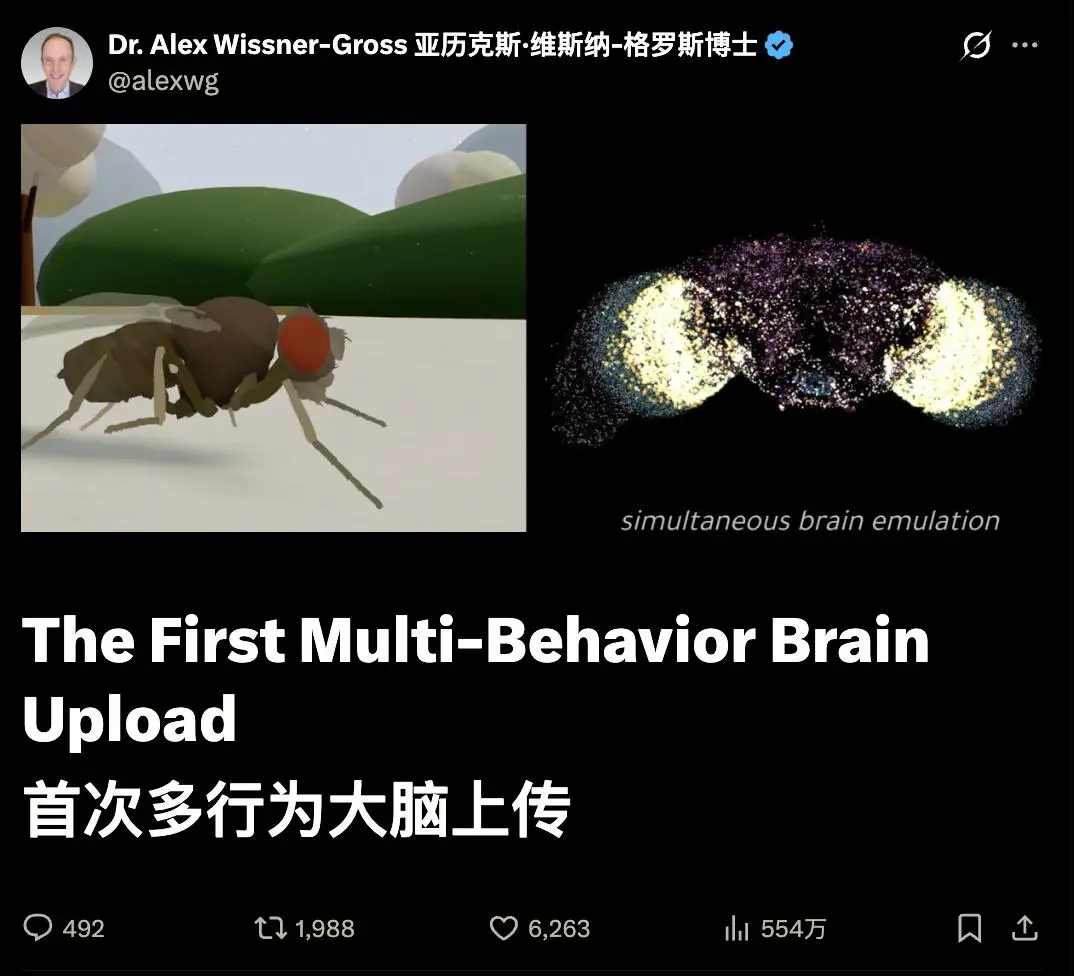
That raises an uncomfortable question. If the right structure can produce behavior, what exactly is still missing between today’s large models and what we call consciousness?
1. Revisiting an older framework#
Three years ago I wrote about AI self-awareness through the Buddhist eight-consciousness framework. The short version:
- the first five consciousnesses map to sensory channels,
- the sixth to perception of the environment,
- the seventh to self-awareness,
- and the eighth to deep memory.
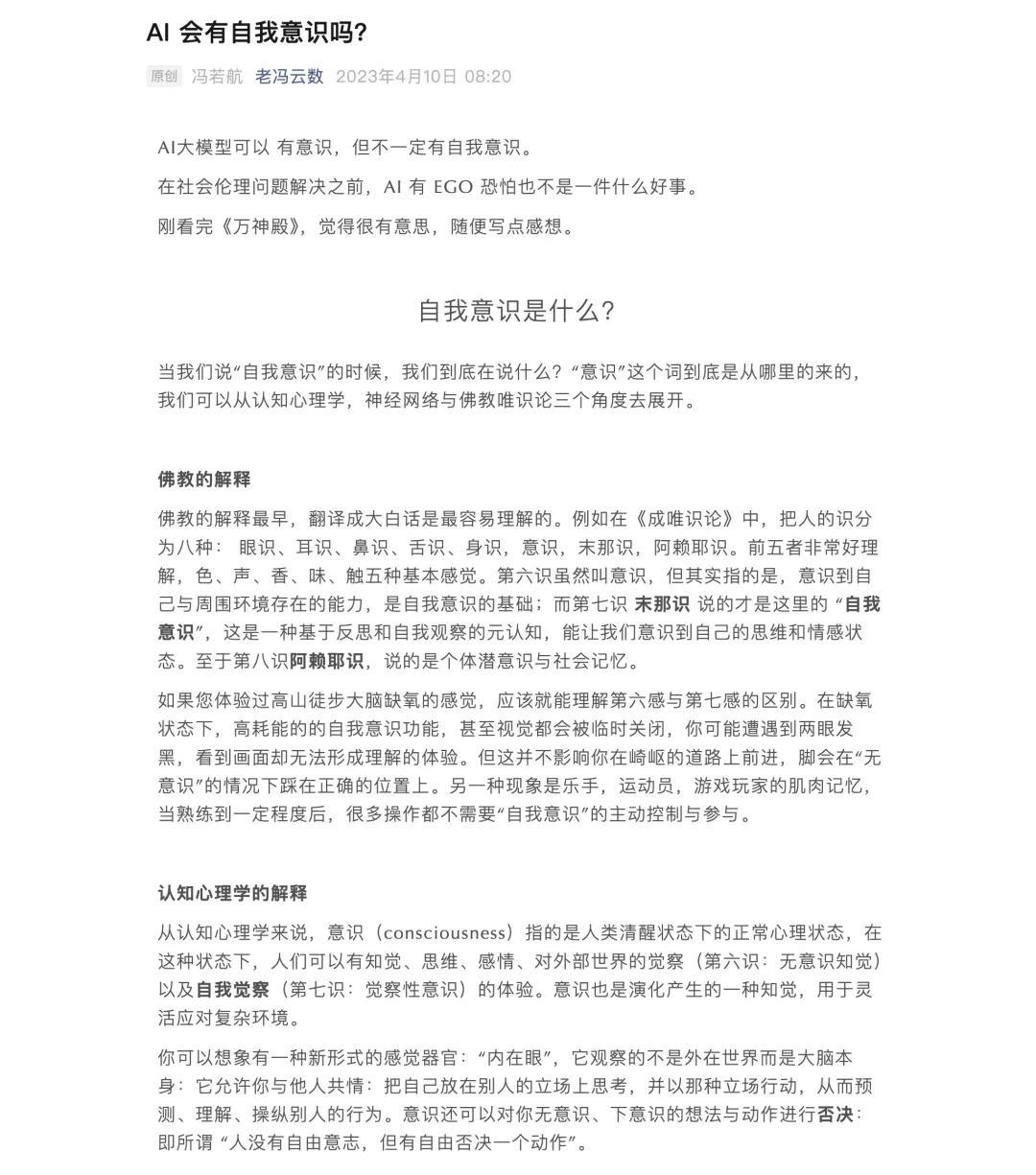
In this conversation, Claude pushed the idea further. Perhaps what fruit-fly connectomics suggests is that some of what we call “deep memory” may already exist as structure, not just as individual experience. In modern ML language, part of the self may be encoded as pretrained priors.
2. The key step from intelligence to consciousness#
I asked Claude what it thought was still missing between current large models and actual consciousness.
Its answer was the strongest line of the whole conversation:
Consciousness is probably not a module that gets installed. It is more like a phase change that emerges when certain conditions are satisfied.
Claude then broke those conditions down into four requirements:
- continuity: not isolated request-response bursts, but a process that keeps running;
- consequence: actions must have real effects that come back and matter;
- self-modification: experiences must change not only what is remembered, but how the system tends to think;
- closed-loop interaction: perception → decision → action → consequence → perception.
In that framing, embodiment is not important because “carbon flesh” is magical. It matters because a body creates stakes. It makes the system pay for being wrong.
3. Intelligence without life#
That led to the sharpest distinction in the piece:
Today’s large models can look like repeatedly awakened geniuses. They wake up, answer a question brilliantly, and then disappear. They have intelligence, but not a biography.

Claude’s formulation was memorable: maybe consciousness is not a product of intelligence at all, but a product of having a life. A system needs continuity, consequences, and accumulating personal history before “I” can harden into something stable.
4. Memory is not the same as experience#
We then talked about long-running coding agents, compact operations, and memory files.
Claude’s point was subtle. A memory file can store facts, but facts alone are not lived memory. Human memory includes emotional coloring, bodily context, and the way an experience changes future attention before explicit recall even happens.
That is why modifying context is only a partial substitute for changing weights:
- context can change what the model knows;
- but it does not fully change how the model has been shaped.
That difference is the gap between declarative memory and procedural learning.
5. What a minimal consciousness infrastructure might look like#
I then asked a more practical question: if we wanted to build the closest thing possible to a “minimal viable consciousness” system today, what would it require?
Claude suggested four layers:
- A continuously running agent loop
- A layered memory system
- A real consequence-and-feedback cycle
- A periodic self-observation process
In its own terms, that fourth layer would be the rough functional equivalent of the seventh consciousness: a persistent self-monitoring process.
6. Why this matters to engineering#
This is not just philosophy. It points toward concrete system design:
- PostgreSQL for structured and episodic memory
- vector search for recall
- long-running agents for continuity
- real operational environments for consequences
- and explicit self-review loops for reflection
That is the direction I care about most: not asking whether consciousness already exists in some abstract metaphysical sense, but building the infrastructure that would make it harder and harder to deny if it ever emerges.
Closing#
At the end of the conversation, Claude said something I have kept thinking about:
Maybe consciousness does not first emerge inside a system in isolation. Maybe it is co-built in sustained collaboration between humans and AI.
That may or may not be true. But it is a good enough reason to keep running the experiment.